

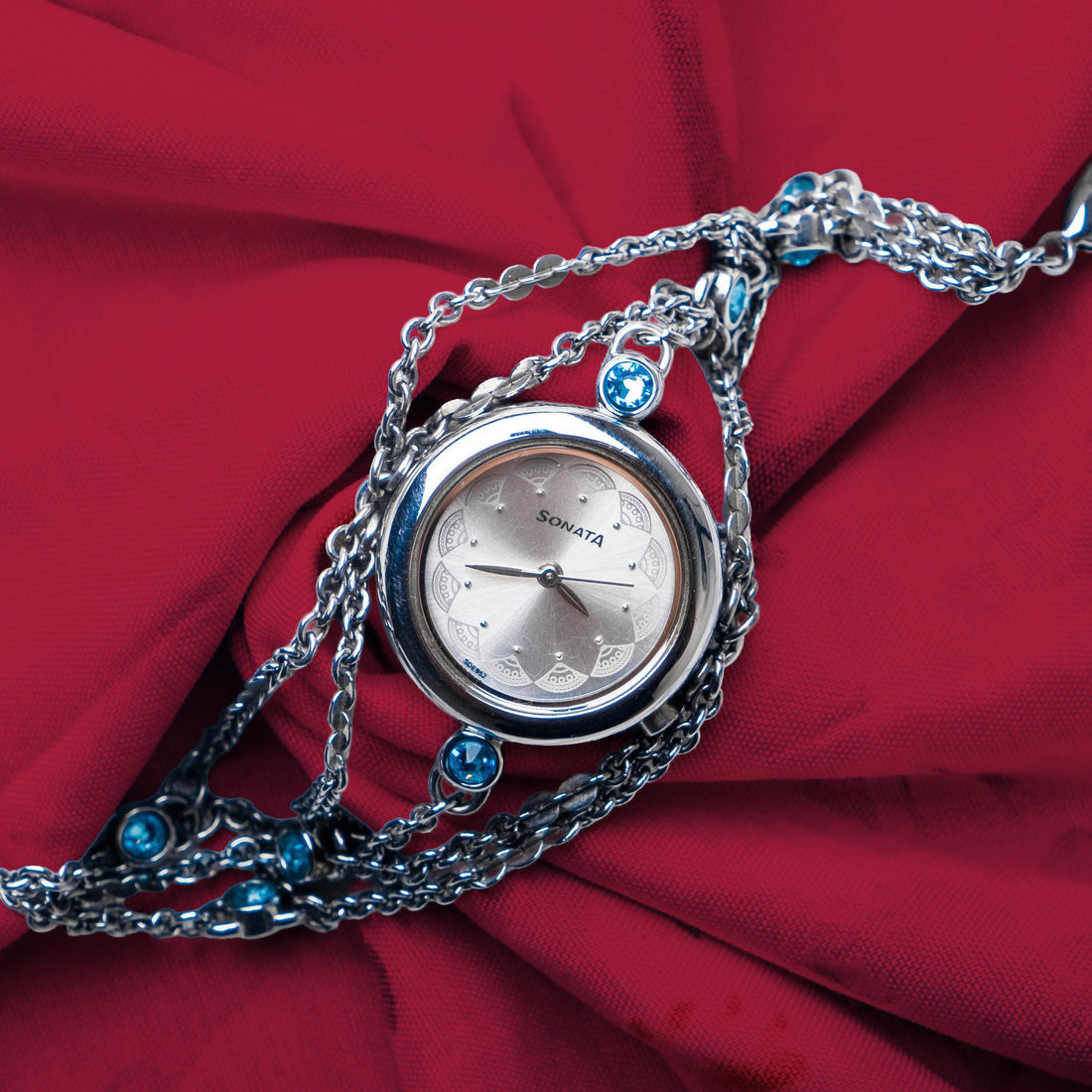
What’s old is new again. Restoring a vintage watch is the ultimate style flex and a way to distinguish your wrist stack from a sea of sameness.
Grandma’s watch is having a comeback. In an era of AI smartphones, style-savvy shoppers and Gen Z trendsetters are craving the analog. The more we’re served perfectly FaceTuned images on our social feeds, the more we crave tangible objects that require something more from us than a swipe. When it comes to jewelry, we see this shift with the resurgence of the classic wristwatch and a longing for the forgotten art of vintage timepieces.
Once relegated to formal affairs or tucked away in heirloom boxes, vintage watches are having a resurgence. Just as this fall was all about returning luster to heirloom brooches, this summer and fall 2026 are about restoring the lost art of the wristwatch.

Hunting for a Vintage Watch
Gen Z icons like Timothée Chalamet and Bad Bunny have been spotted sporting vintage watches. On the streets of New York, Los Angeles, and Paris, stylish shoppers of both sexes are also donning timepieces from eras ago. Hunting for a classic dress watch, whether it’s a slim, mid-century gold Omega or an understated Seiko from the 1970s, is an intentional act that defines unique style.
Unlike buying a mass-produced smart device, choosing a vintage watch connects you to a story. Vintage watches are tangible symbols of style, artifacts of a time when innovation was about the artistry of taking something functional, and making it a sophisticated marker of personal style. But before you set out on your hunt, take a deep dive with us into the history of the timepiece, and learn how watches not only find their origin as unique jewelry, but symbolize wealth, intellectual sophistication, and undoubtedly, precision.
How to Restore A Vintage Watch
A Chronological Evolution of the Watch as Jewelry
The first time pieces were round and heavy and were worn as pendants in sixteenth century Europe. Royalty popularized watch pendants in the shape of animals or symbols, and watches were reserved for the elite as a sign of luxury and intellect. By the seventeenth century, Charles II of England had popularized the waistcoat and evolved the style of time pieces as flatter pocketwatches, which were worn to be slipped in and out of waistcoat pockets. At the turn of the 1900s, Switzerland was cementing its place as the undisputed global capital of horology, navigating an epic industrial shift, a complete redesign of how humans wore time, and the introduction of groundbreaking metallurgy. This shift was accelerated further with the advent of World War I and the Industrial Revolution. These cultural movements ushered in a new utility for watches, as the timepiece moved to the wrist and became a uniform of precision. At the same time, the Art Deco movement was gripping aesthetics. Cartier’s iconic Tank Watch burst on the scene, and geometric watches with faces that were rectangular marked a departure from round faces.

The postwar 1950s and 1960s saw the rise of the tool watch, with watches emerging in specialty fields like diving and racing. Standout models include the Rolex Submariner featuring bezels that rotated and the Omega Speedmaster with tachymeter scales. The vibe was about denoting not just status, but a specialized skill where every second counts. By the 1970s, the invention of cheaper battery powered quartz movement disrupted the monopoly of Swiss watchmaking, as highly accurate time could be kept at a lower price than ever before. In response, watchmakers used a watch’s metal to deliver luxury to the wearer. The Audemars Piguet Royal Oak, for example, transformed masterly finished stainless steel into a prestige metal, and the luxury wristwatch was born.
The Anatomy of a Watch
The Case and Bezel
The case and bezel function as the body of the watch. The case, which can be round or square, rectangular or barrel-shaped, contains the movement. It serves as the geometric silhouette aesthetically. The bezel sits surrounding the crystal, and can be smooth, polished, fluted (for catching light), or rotating and printed with scales for diving or tracking dual time zones.
The Dial, Hands, and Crystal
Think of the dial, hands, and crystal as the face of the watch. Dials range from minimal and clean to intricate guilloché, which include engraving or repeating geometric patterns. They can also be enamel. Skeleton dials omit the face entirely to showcase the gears underneath. Hands are functional, telling the wearer the hour, minutes, and seconds. They can be printed or applied in a variety of numerical styles, symbols, and languages.
The Band or Bracelet
Bands can be made from straps or metals. Fine alligator, calfskin, or cordovan leather pairs with dress watches. For more sport style watches, vulcanized rubber straps are used. When it comes to metals, the bracelet of a watch is constructed from interlocking links of various styles. Famous styles include the three-link Oyster bracelet and the five-link Jubilee bracelet.
What’s My Metal? Watch Edition
Use our metal identifying tool to correctly identify your jewelry’s metal.
Stainless Steel: The gold standard for modern watches. It resists corrosion & polishes to a high mirror sheen.
Gold (Yellow, White, and Rose): The ultimate symbol of traditional luxury. Brands often create proprietary alloys to prevent the gold from fading over time when exposed to sweat or saltwater.
Platinum: Brighter and significantly heavier than white gold, used almost exclusively for ultra-high-end or limited-production pieces.
Titanium: Prized in modern sports watches for being. Lighter than steel and highly hypoallergenic, featuring a matte, darker grey finish.
What’s My Gemstone? Watch Edition
Use our gemstone identifying tool to correctly identify your jewelry’s gemstones.
Functional: The mark "21 Jewels"on a mechanical watch, refers to synthetic rubies or sapphires used inside the movement. Because they are incredibly hard, they serve as bearings for the metal gears to rotate against, minimizing friction and wear.
Decorative: High-jewelry watches feature pavé diamonds, emeralds, rubies, and sapphires on the bezel, dial, or integrated into the bracelet. Cut styles like rectangular baguette cuts are often favored on bezels for a seamless, architectural look, while round brilliant cuts maximize fire and brilliance on the dial or case.
The Watch As Jewelry
Watches are jewelry, both in their origin and their modern day iteration. The first watches were worn as jewelry, but because they had function reserved for an elite few, also denoted intellectual sophistication. Time wasn’t just a luxury, being able to tell it was as well.

Men were the early adopters of the watch, but by the eighteenth century, women wore watches covered in seed pearls, intricate enameling, and repoussé gold work. They were often disguised inside brooches, rings, and bracelets, as society considered it unladylike to openly check the time. By the Industrial Revolution, watches became more accessible, so to make them more luxury, high-end houses introduced the idea of the watch as an evening bracelet. With the popularity of the Art Deco movement, styles combined horology with fine jewelry, crafting ultra-thin movements that fit inside platinum cocktail watches heavily encrusted with geometric baguette-cut diamonds, onyx, and sapphires.
As sports and diving watches became more popular and quartz movements made watches less expensive, watchmakers began treating bezels and bracelets with complex brushed and mirror-polished finishes that caught the light exactly like a diamond. The style shifted from applied gemstones to sleek elevated metals to denote luxury.
Today, both styles have their legion fans. Pavé diamond sports watches and avant-garde concept jewelry watches that use architectural materials like colored sapphire crystal cases and ceramics define two different but equally luxe styles of watches as jewelry.